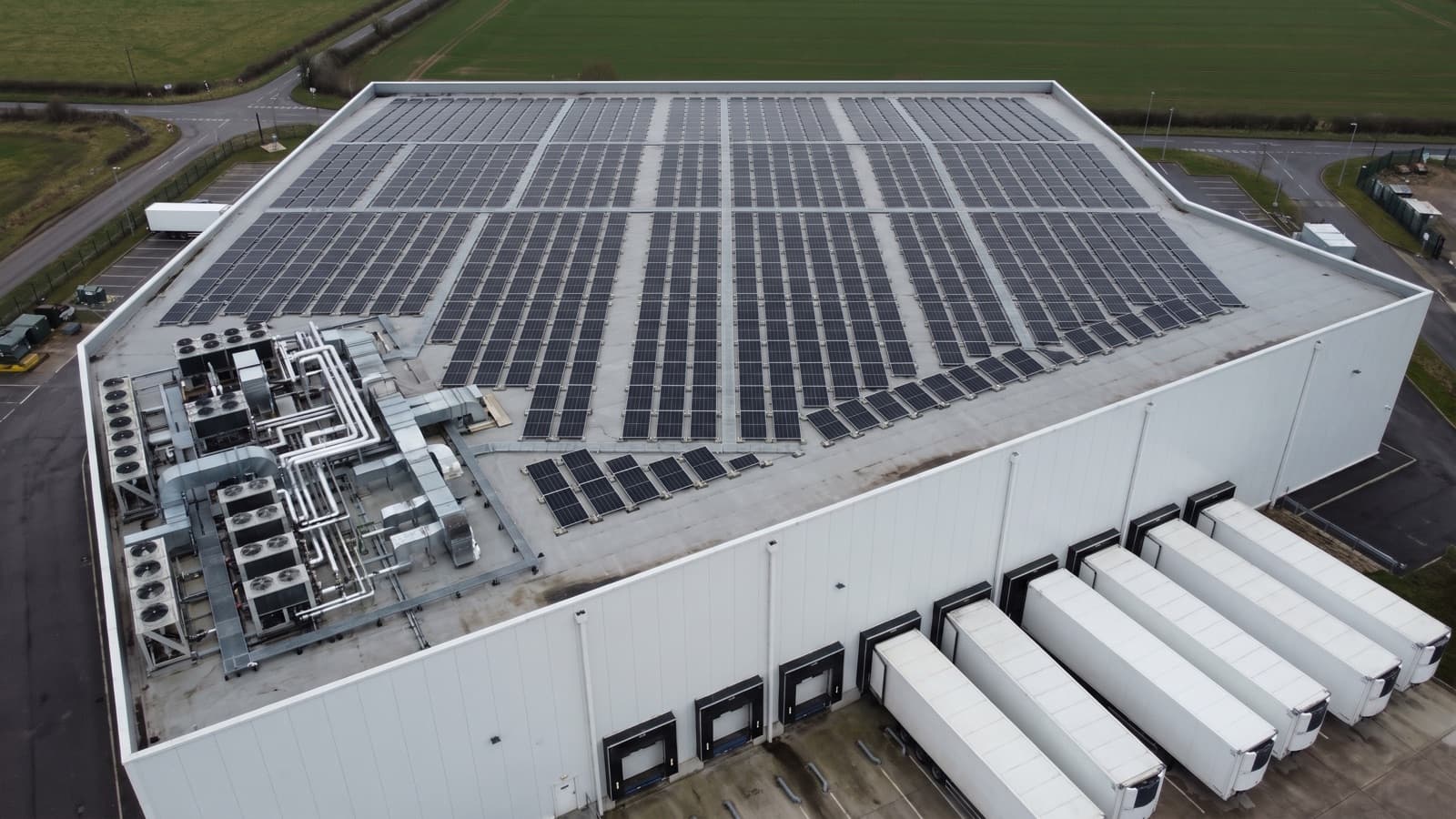
The short answer
Cold stores are among the best buildings in the UK for rooftop solar. Refrigeration is a large, near-constant load with a strong daytime component, so a cold store self-consumes most of what its roof generates — displacing grid electricity at around 25p per kWh. On a large, low-cost roof at £700–£1,000 per kWp, that pushes payback toward the 2–5 year end of commercial solar.
A refrigerated warehouse has a near-perfect load profile for solar. The compressors run through the day to hold temperature, the demand is steady rather than peaky, and a large chunk of it falls inside the hours when panels generate. That means most of the output is used on site instead of being exported for a fraction of its value. This guide sets out the figures independently — we don't install anything. When you want a number for your building, the calculator gives you one in about a minute.
Why cold store roofs work for solar
The strength of a cold store is its load, not just its roof. Refrigeration is one of the few commercial loads that is both large and close to constant: a chiller or freezer plant draws power continuously to hold temperature, and that demand rises in the warmer daytime hours when solar is generating hardest. The result is high self-consumption — the share of generation used on site rather than exported.
Self-consumption is what drives the return. Every unit generated and used on site displaces a grid unit costing 25–30p; every exported unit earns far less. A cold store's steady daytime refrigeration demand lines up closely with when panels generate, which is why cold stores sit at the faster end of commercial payback — alongside warehousing and logistics, rather than offices that empty out and go quiet.
| Building type | Typical payback | Annual ROI | Why |
|---|---|---|---|
| Cold store / refrigerated warehouse | 2–5 years | 22–45% | Large constant refrigeration load, high daytime self-consumption |
| General warehouse / logistics | 2–5 years | 22–45% | Large roof, daytime operation |
| Offices | 5–7 years | 15–28% | Lower, peakier daytime load |
What solar costs for a cold store
Cold stores are often large buildings, and size works in your favour: solar is priced per kWp (kilowatt-peak), and the per-unit cost falls sharply as the system grows. Large refrigerated-warehouse roofs reach the £700–£1,000 per kWp band, the lowest in the commercial market. As a guide for 2026:
| System size | Typical installed cost | Roughly suits |
|---|---|---|
| 50 kWp | £63,900–£70,000 | Smaller cold store, ~£2k–£3k/mo electricity |
| 100 kWp | £80,000–£95,000 | Mid-size refrigerated unit |
| 150 kWp | £112,500–£127,500 | Larger cold store |
| 500 kWp | £375,000–£425,000 | Large refrigerated distribution centre |
Note how the cost per kWp falls from around £1,300 on a small system towards £700–£1,000 at this scale. The headline price isn't the whole story — what matters is the cost against the savings it unlocks, and a high-self-consumption site converts those savings efficiently. Our commercial solar cost guide breaks down exactly what sits inside a quote.
Why cold stores convert so well
Is your cold store suitable?
Most refrigerated warehouses make strong candidates. A few checks decide it quickly:
- Roof size and condition — you want a large, clear roof with at least 10 years of life left. A structural survey (£500–£2,000) confirms it can carry the load; an asbestos-cement roof usually needs replacing first.
- Refrigeration load profile — the more of your chiller or freezer demand that runs while the sun is up, the higher the self-consumption and the faster the return. A constant daytime load is exactly what solar wants to see.
- Electricity supply — cold stores generally have a three-phase supply, which a larger commercial system needs. Confirm the incoming capacity before sizing.
- Tenure — owner-occupiers have the simplest path; tenants need landlord consent and enough lease left to recoup the cost.
Planning and grants for cold stores
Rooftop solar on a cold store rarely needs planning permission. Since December 2023, permitted development rights in England cover commercial rooftop solar of any size, provided panels sit at least 1m from the roof edge and protrude no more than 200mm on a pitched roof (or 1m on a flat roof). Listed buildings and conservation areas are the exceptions, and building regulations always apply — flat roofs in particular need a BROOF(t4) fire rating. Full detail is on our planning permission guide.
On funding, there is no universal UK grant for commercial solar and none specific to cold stores, but the tax treatment is generous: the £1m Annual Investment Allowance deducts 100% of the cost from year-one profits — worth about 25% of the project back at the 25% corporation tax rate — and solar is exempt from business rates in England. Our grants and tax relief guide keeps a maintained list of live schemes by nation.
Frequently asked questions
Why do cold stores pay back solar faster than other buildings?+
Refrigeration is a large, near-constant electrical load with a strong daytime component, so a cold store uses most of what its roof generates on site rather than exporting it. Every self-consumed unit displaces grid electricity at around 25p per kWh, which is worth far more than an export payment. High self-consumption on a low-cost large roof is what pushes payback toward the 2–5 year end of the commercial range.
How big a solar system does a refrigerated warehouse need?+
Size it to your daytime electricity use, not the roof. Cold stores are often large buildings, so the roof can usually hold more than the load needs — a typical commercial system needs about 6 m² of roof per kWp, so a 2,000 m² roof could carry around 300 kWp. The aim is to match generation to the refrigeration demand that runs while the sun is up, maximising self-consumption.
Can a cold store roof carry the extra weight of solar panels?+
Usually, but it must be confirmed by a structural survey, typically £500–£2,000. The survey checks the roof and frame can take the added distributed weight of panels and mounting. Older units, lightweight roofs or any asbestos-cement covering need particular care, and an asbestos roof generally has to be replaced before panels can be fitted. Insulated panel roofs common on cold stores are usually straightforward but still need checking.
Are there grants for solar on cold stores?+
There is no grant specific to cold stores, and no universal UK solar grant. The dependable support is tax relief: the £1m Annual Investment Allowance deducts 100% of the project cost from year-one profits, worth about 25% back at the 25% corporation tax rate, and solar is exempt from business rates in England. As of September 2026 no government grant for business rooftop solar is open; our grants guide tracks each scheme's status by nation.
See what solar could save your business
Enter your roof size, postcode and monthly bill — get your system size, savings and payback in 60 seconds. Free, no obligation.
Get my free estimateRelated guides
Updated June 2026 · By Taro Schenker, founder of Business Solar Check. We're independent — we don't install solar. Figures are indicative UK averages; your site survey confirms the numbers for your roof.