The short answer
Solar on farm buildings typically pays back in 5–7 years, and faster where daytime loads are heavy — grain drying, refrigeration and milking all run while the sun is up. Most modern steel-frame barns offer large, well-oriented roofs at the right cost, with on-site solar generating at an effective 5–8p per kWh against grid prices of 25–30p.
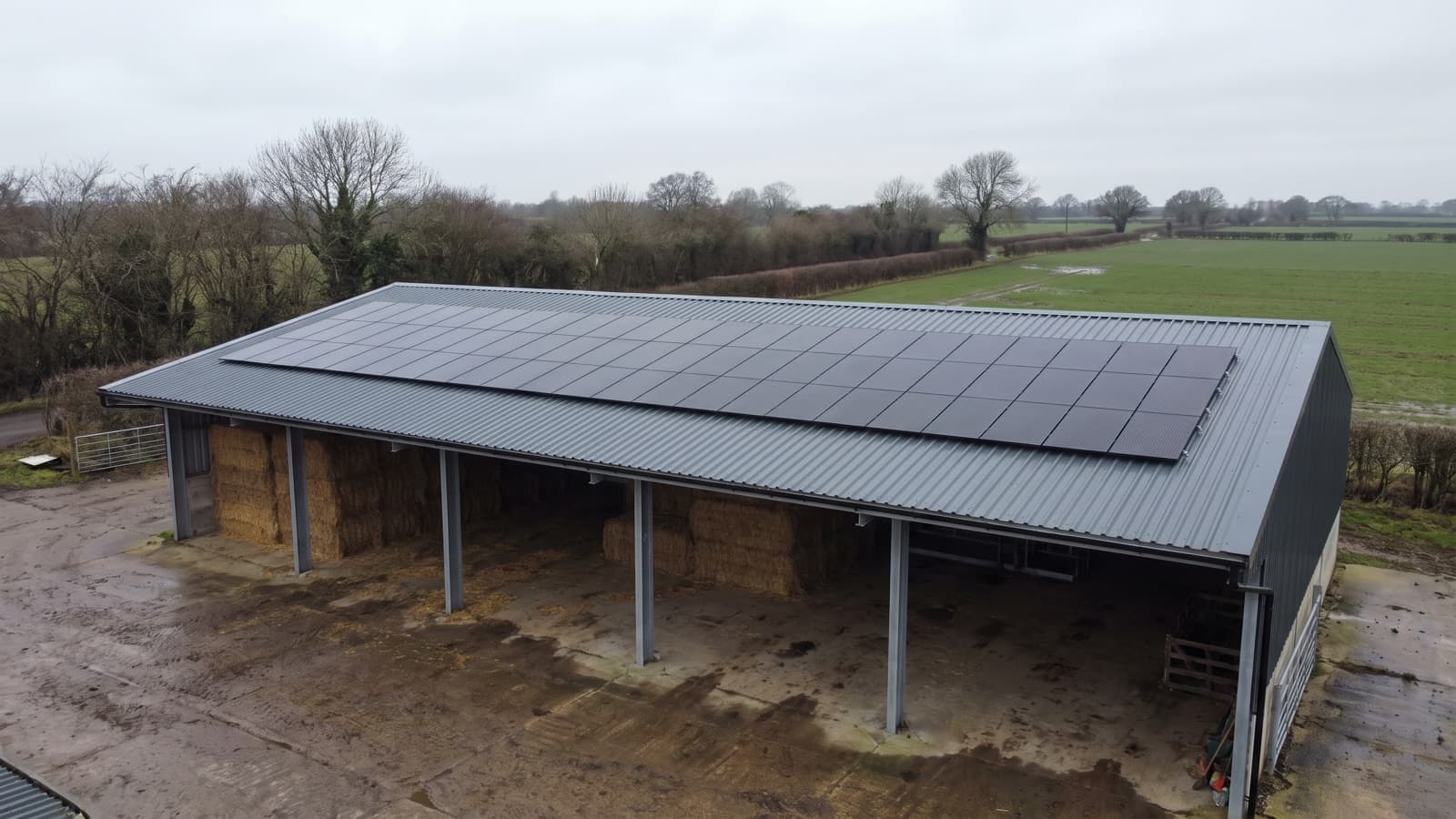
Few buildings suit rooftop solar as naturally as a modern farm shed. The roofs are large and uncluttered, much of the electricity is used during daylight, and many holdings already have the three-phase supply a commercial system wants. This guide sets out the figures independently — we don't install anything. When you want a number for your buildings, the calculator gives you one in about a minute.
Big roof or spare land? Two different routes
Why farm building roofs work for solar
The case for barn-roof solar rests on two things: the building and the load. Most modern steel-frame barns combine a large, simple roof plane with daytime electricity demand that lines up well with when panels generate.
On the building side, most modern steel-frame barns are designed to span wide, open spaces, and a typical solar array adds a modest, well-distributed weight to the roof. A structural survey still confirms it on every site — older or non-standard frames, and any roof with an asbestos-cement covering, need particular care.
On the load side, the farm activities that use the most power tend to run in daylight, which is exactly what makes solar pay. Every unit generated and used on site displaces a grid unit costing 25–30p; every exported unit earns far less. The strongest matches:
- Grain drying — heavy, seasonal daytime load through harvest, often the single biggest electricity user on an arable farm.
- Refrigeration and cold storage — continuous cooling for produce, dairy or stored crops runs day and night, with a strong daytime base.
- Milking and dairy — parlour vacuum pumps, milk cooling and water heating give a regular twice-daily demand.
What solar costs for a farm building
Farm-building systems span a wide range because barn roofs vary so much in size. Solar is priced per kWp (kilowatt-peak) of capacity, and bigger arrays cost less per unit because fixed costs — scaffolding, design, grid paperwork — spread further. As a guide for 2026:
| System size | Typical installed cost | Roughly suits |
|---|---|---|
| 25 kWp | £31,950–£35,000 | Smaller holding, single barn roof |
| 50 kWp | £63,900–£70,000 | Mixed farm, ~£2k–£3k/mo electricity |
| 100 kWp | £80,000–£95,000 | Larger barn / multiple buildings |
| 150 kWp | £112,500–£127,500 | Large arable or dairy operation |
Note how the cost per kWp falls from around £1,300 on a smaller system towards £750–£950 at scale. The headline price isn't the whole story — what matters is cost against the savings it unlocks. Our commercial solar cost guide breaks down exactly what sits inside a quote.
A sense of the returns
Agricultural sites with strong daytime demand sit at the better end of commercial payback. Typical UK commercial rooftop yield is around 950 kWh per kWp per year, so a 100 kWp barn array generates roughly 95,000 kWh a year. Used on site against 25–30p grid electricity, that displaces a meaningful share of a working farm's bill.
Payback on farm buildings typically lands in the 5–7 year range, shortening where a high, steady daytime load — drying through harvest, year-round refrigeration — lifts self-consumption. Over a 25-year-plus panel life that leaves a long tail of near-free power. Our payback and ROI guide works through the returns by building type with real installations.
Is your farm building suitable?
Most working farms have at least one good candidate roof. A few checks decide it quickly:
- Roof size and condition — you want a large, clear roof plane with at least 10 years of life left. An asbestos-cement covering usually means re-roofing first.
- Electricity supply — most useful systems need a three-phase supply, which many farms already have for drying, milking or workshop machinery. Single-phase holdings are limited to small arrays.
- Daytime use — the more power you use while the sun is up, the better the return. Drying, cooling and milking are ideal matches.
- Tenure — owner-occupiers have the simplest path; tenant farmers need landlord consent and enough years left on the agreement to recoup the cost.
Planning and grants for farm solar
Rooftop solar on most agricultural buildings does not need planning permission. Since December 2023, permitted development rights in England cover commercial rooftop solar of any size, provided panels sit at least 1m from the roof edge and protrude no more than 200mm on a pitched roof (or 1m on a flat roof). Listed buildings, scheduled monuments and conservation areas are the exceptions, and building regulations always apply. Full detail is on our planning permission guide.
On funding, there is no universal UK grant for commercial solar, but the tax treatment is generous: the £1m Annual Investment Allowance deducts 100% of the cost from year-one profits — worth about 25% of the project back at the 25% corporation tax rate — and solar is exempt from business rates in England. Round 2 of the Improving Farm Productivity grant (England) paid 25% of rooftop or reservoir solar (£15,000–£100,000, no ground-mount); it is closed, and no round is open as of September 2026. The Farming Equipment and Technology Fund does not fund solar panels. Rounds open and close, so check gov.uk's Funding for farmers page before you plan around one. Our grants and tax relief guide tracks each scheme's status by nation.
Frequently asked questions
Do you need planning permission for solar panels on farm buildings?+
Usually not. Since December 2023, permitted development rights cover rooftop solar of any size on commercial buildings in England, which includes most agricultural buildings — provided panels sit at least 1m from the roof edge and protrude no more than 200mm on a pitched roof. Listed buildings, scheduled monuments and conservation areas are the main exceptions, where full permission is needed.
Can I put solar on an old asbestos barn roof?+
Not directly. Older barn roofs containing asbestos cement cannot safely carry a solar install, and most installers will not fix panels to them. The usual route is to replace the roof first — often with insulated steel sheeting — which also removes a liability and resets the roof's life. That re-roofing cost should be budgeted alongside the solar, not ignored.
Do farms have the three-phase supply solar needs?+
Often, yes. Many working farms already run three-phase for grain dryers, milking parlours, refrigeration or workshop machinery, which is exactly what a larger commercial solar system wants. If a holding is single-phase, system size is usually capped at a small array, so confirming the incoming supply is one of the first checks before sizing anything.
Can I sell power back to the grid from a farm roof?+
Yes, through a Smart Export Guarantee tariff, but export pays far less than the 25–30p per kWh you avoid by using power on site. The economics favour matching generation to daytime farm loads — drying, cooling, milking — and exporting only the surplus. A battery or a second daytime load can lift self-consumption and improve the return.
See what solar could save your business
Enter your roof size, postcode and monthly bill — get your system size, savings and payback in 60 seconds. Free, no obligation.
Get my free estimateRelated guides
Updated June 2026 · By Taro Schenker, founder of Business Solar Check. We're independent — we don't install solar. Figures are indicative UK averages; your site survey confirms the numbers for your roof.