The short answer
Solar on industrial buildings typically pays back in 3–5 years with an annual return of 19–36%. Large industrial unit roofs reach the lowest per-kWp cost band — £700–£1,000 per kWp — and steady daytime machinery loads mean a high share of the power is used on site, where it displaces grid electricity at 25–30p per kWh.
Industrial units are among the strongest sites for rooftop solar in the UK. The roofs are large and uncluttered, production machinery draws power through the working day, and the scale pushes the cost per unit down to the bottom of the commercial range. This guide sets out the figures independently — we don't install anything. When you want a number for your building, the calculator gives you one in about a minute.
Why industrial unit roofs work for solar
The case rests on scale and load. A large industrial roof spreads the fixed costs of a solar project — scaffolding, design, grid paperwork — across far more capacity, which is why industrial buildings reach the lowest per-kWp prices. At the same time, the electricity demand on a production site tends to track the working day, so most of what the panels generate is used on site rather than exported.
That self-consumption is what drives the return. Every unit generated and used on site displaces a grid unit costing 25–30p; every exported unit earns far less. Steady daytime machinery, compressors, extraction and process heat all line up well with when panels generate, which is why industrial sites sit at the faster end of commercial payback.
| Profile | Typical payback | Annual ROI | Why |
|---|---|---|---|
| Single daytime shift | 3–5 years | 19–36% | High self-consumption across the solar window |
| Two-shift / extended hours | 3–5 years | 19–36% | Demand overlaps generation for longer |
| Energy-intensive manufacturing | 3–5 years | 19–36% | Heavy continuous daytime process load |
What solar costs for an industrial building
Industrial systems are usually large, which works in your favour: solar is priced per kWp (kilowatt-peak), and the per-unit cost falls sharply with size. Large industrial roofs reach the £700–£1,000 per kWp band, the lowest in the commercial market. As a guide for 2026:
| System size | Typical installed cost | Roughly suits |
|---|---|---|
| 50 kWp | £63,900–£70,000 | Smaller unit, ~£2k–£3k/mo electricity |
| 100 kWp | £80,000–£95,000 | Mid-size industrial unit |
| 150 kWp | £112,500–£127,500 | Larger unit / light manufacturing |
| 500 kWp | £375,000–£425,000 | Large production site |
Note how the cost per kWp falls from around £1,300 on a small system towards £700–£1,000 at industrial scale. The headline price isn't the whole story — what matters is cost against the savings it unlocks. Our commercial solar cost guide breaks down exactly what sits inside a quote.
A real industrial installation
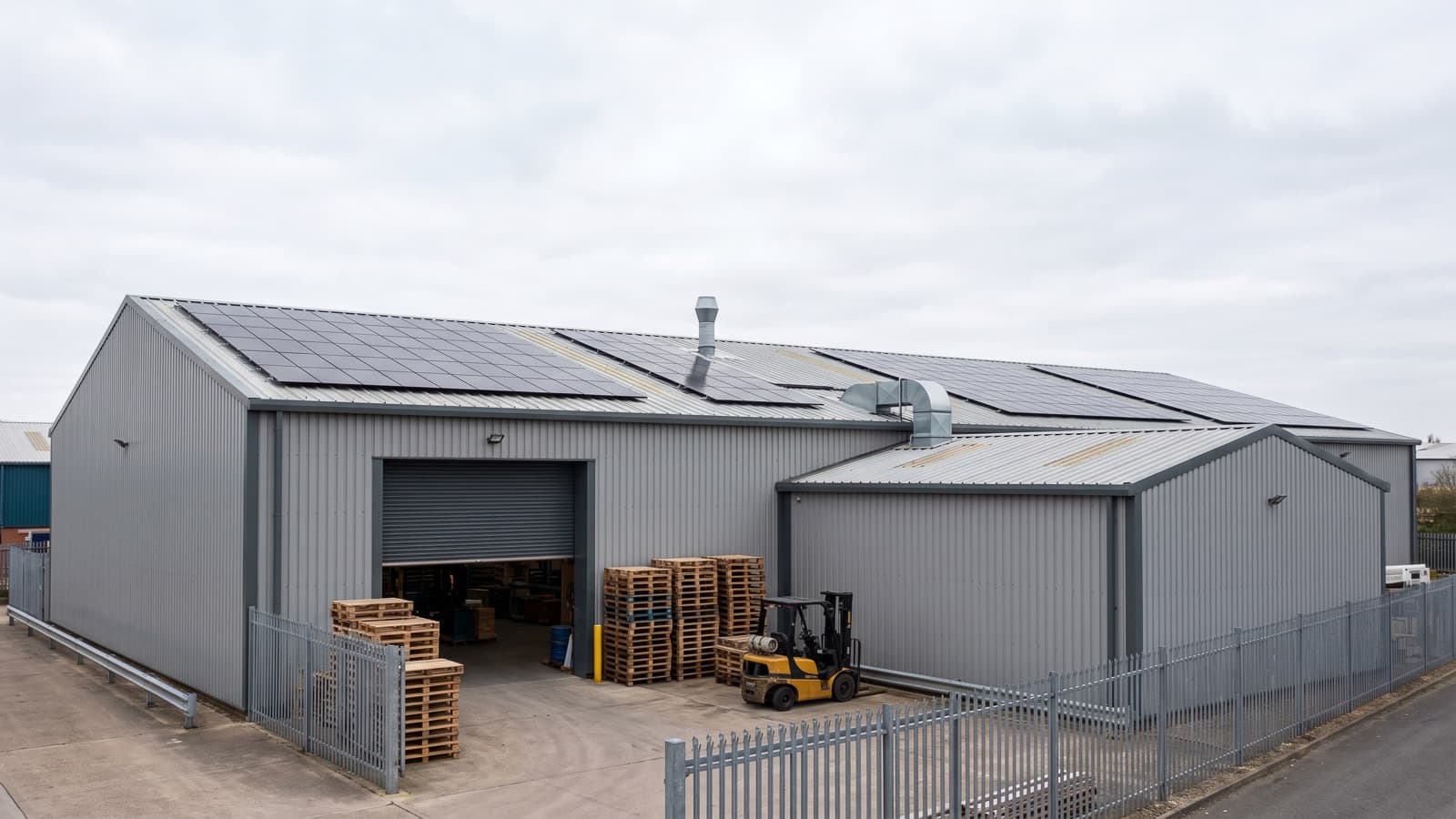
The numbers are easiest to grasp from a real site. GCB Cocoa, a cocoa-processing operation in Suffolk, installed a 944 kWp rooftop array that generates around 877,862 kWh a year and avoids roughly 181,782 kg of CO₂ annually. On an energy-intensive production site, almost all of that generation is used on site, displacing grid electricity at 25–30p per kWh.
Why industrial sites do so well
Is your industrial building suitable?
Most industrial units make good candidates. A few checks decide it quickly:
- Roof size and condition — you want a large, clear roof with at least 10 years of life left. A structural survey (£500–£2,000) confirms it can carry the load; an asbestos-cement roof usually needs replacing first.
- Electricity supply — industrial units generally have a three-phase supply, which a larger commercial system needs. Confirm the incoming capacity before sizing.
- Daytime use — the more machinery runs while the sun is up, the higher the self-consumption and the faster the return.
- Tenure — owner-occupiers have the simplest path; tenants need landlord consent and enough lease left to recoup the cost.
Planning and grants for industrial units
Rooftop solar on industrial buildings rarely needs planning permission. Since December 2023, permitted development rights in England cover commercial rooftop solar of any size, provided panels sit at least 1m from the roof edge and protrude no more than 200mm on a pitched roof (or 1m on a flat roof). Listed buildings and conservation areas are the exceptions, and building regulations always apply — flat industrial roofs in particular need a BROOF(t4) fire rating. Full detail is on our planning permission guide.
On funding, there is no universal UK grant for commercial solar, but the tax treatment is generous: the £1m Annual Investment Allowance deducts 100% of the cost from year-one profits — worth about 25% of the project back at the 25% corporation tax rate — and solar is exempt from business rates in England. The Industrial Energy Transformation Fund, often cited for manufacturers, has closed and never funded solar panels. Our grants and tax relief guide tracks each scheme's status by nation.
Frequently asked questions
How many solar panels fit on an industrial unit roof?+
It depends on the clear roof area, not the panel count. As a rough guide, a commercial rooftop system needs about 6 m² of roof per kWp of capacity, so a 1,000 m² industrial roof supports roughly a 150 kWp system. The usable area is what is left after rooflights, plant, walkways and the required edge clearance are taken out.
Do shift patterns affect how well solar works on an industrial unit?+
Yes, strongly. Solar pays best when you use what you generate, so a single daytime shift captures most of the output directly. A two-shift or 24-hour operation with steady daytime machinery does even better, because demand overlaps generation across the whole solar window. Night-only operations gain least and lean more on export or storage.
Can an industrial unit roof carry the extra load of solar?+
Usually, but it must be confirmed. A structural survey checks that the roof and frame can take the additional distributed weight of panels and mounting, typically £500–£2,000. Older units, lightweight roofs or any asbestos-cement covering need particular care, and an asbestos roof generally has to be replaced before panels can be fitted.
Can an industrial unit get the IETF grant for solar?+
No. The Industrial Energy Transformation Fund closed to new applicants after the 2025 Spending Review, with no successor planned, and its guidance excluded solar panels even when it was open. There is no universal solar grant; for most units the AIA tax relief is the dependable support.
See what solar could save your business
Enter your roof size, postcode and monthly bill — get your system size, savings and payback in 60 seconds. Free, no obligation.
Get my free estimateRelated guides
Updated June 2026 · By Taro Schenker, founder of Business Solar Check. We're independent — we don't install solar. Figures are indicative UK averages; your site survey confirms the numbers for your roof.