The short answer
Solar on a retail park or retail unit typically pays back in 4–7 years. Trading-hours demand — lighting, refrigeration, heating and cooling — lines up with when a roof array generates, so self-consumption is high. Large flat roofs and open car parks suit panels and solar carports, but in a multi-unit estate the saving and the cost can fall to different parties.
Retail parks are an unusually good solar prospect for two reasons that most sites don't share: the electricity demand is concentrated in daylight trading hours, and there is space twice over — large flat roofs and a car park that can carry a solar canopy. The complication is tenure: retail parks are typically multi-let, so who benefits has to be settled early. This guide sets out the real numbers independently. We don't install anything; when you want a figure for your roof, the calculator gives you one in about a minute.
Why retail park roofs work for solar
The case for retail solar rests on the load profile. A retail unit draws most of its electricity while it trades — lighting, tills and IT, heating and cooling, and refrigeration in food and grocery units that runs hardest on warm days. That demand sits across the middle of the day, which is exactly when a rooftop array produces power. The overlap matters more than the headline system size, because every unit you generate and use yourself displaces a grid unit costing around 25p per kWh, while every unit you export earns far less.
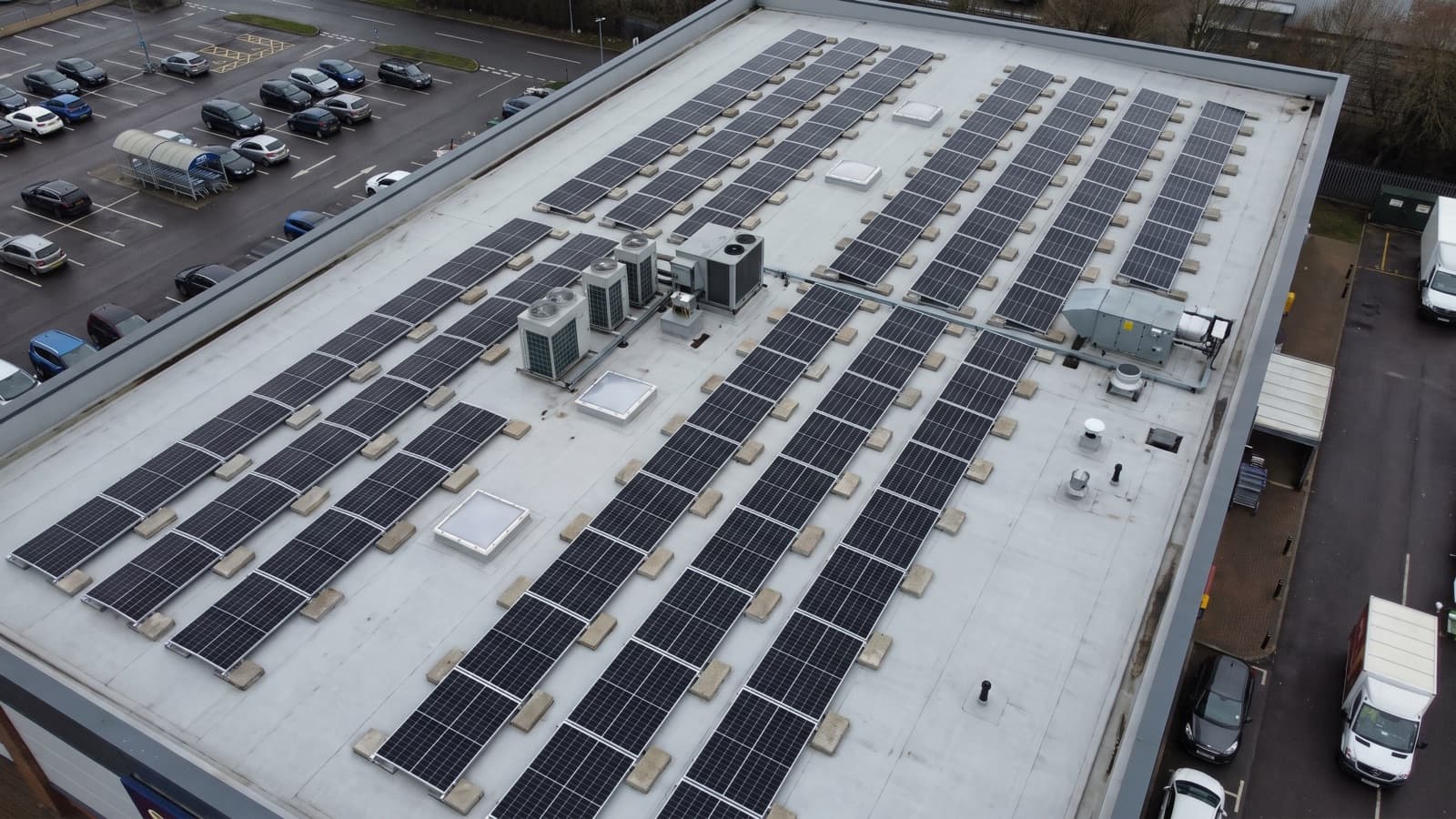
Retail parks also tend to have the right roofs: large, single-storey, lightly serviced flat or shallow-pitched spans with few obstructions. That gives a high usable area and keeps the cost per kWp down compared with a small, cluttered roof. Refrigeration load in particular strengthens the fit, because it draws steadily through opening hours and peaks in the warm, bright conditions when generation peaks too.
Flat roofs and fire rating
Solar carports: using the car park too
A retail park's car park is often as large as its roofs, faces open sky, and is already a hard-standing structure — which makes it a natural place to add generation when the roofs alone don't cover demand. A solar carport is a steel canopy of panels built over the parking bays; it generates power, shelters customers' vehicles, and is an obvious place to add electric-vehicle charging served partly by the panels above it.
The trade-off is cost. A carport carries the price of the steel frame and foundations on top of the panels and inverters, so it costs more per kWp than a rooftop system and pays back more slowly. The usual order is therefore to fit the roofs first, where the economics are strongest, and add canopies only if more capacity is wanted — for EV charging, additional self-consumption, or a visible sustainability statement at the front of the estate.
What does retail solar cost?
Cost depends on system size, and bigger systems cost less per kWp because the fixed costs — scaffolding, design, grid paperwork — spread over more panels. Retail units span a wide range, from a single mid-size unit to a whole estate of large roofs. As a guide for 2026:
| System size | Typical installed cost | Roughly suits |
|---|---|---|
| 25 kWp | £31,950–£35,000 | Single mid-size unit, ~£1k–£1.5k/mo bill |
| 50 kWp | £63,900–£70,000 | Larger unit or anchor store, ~£2k–£3k/mo bill |
| 100 kWp | £80,000–£95,000 | Large unit or several roofs combined |
| 150 kWp | £112,500–£127,500 | Multi-unit estate roofs combined |
Cost per kWp falls from around £1,300–£1,500 on smaller systems towards £750–£950 above 100 kWp, so combining several unit roofs into one larger scheme improves the economics. The headline price isn't the whole story, though — what matters is the cost against the savings it unlocks. Our commercial solar cost guide breaks down exactly what sits inside a quote.
Payback and returns for retail parks
Retail and leisure payback typically lands in the 4–7 year range, with an annual return in the region of 15–30%, varying with opening hours and roof size. Sites that trade long hours and carry refrigeration use a high share of what they generate, which is what pushes a project towards the faster end of that range.
| Building type | Typical payback | Annual ROI |
|---|---|---|
| Retail / leisure | 4–7 years | 15–30% |
| Offices | 5–7 years | 15–28% |
| Warehousing / logistics | 2–5 years | 22–45% |
A roughly 50 kWp array generating at a typical UK yield of about 950 kWh per kWp a year produces in the region of 47,500 kWh annually. At 25p per kWh, a system that self-consumes most of that displaces several thousand pounds of grid electricity each year. Our payback and ROI guide works through the maths in full, including how the returns shift with self-consumption.
Who benefits: landlord, tenant, or both?
This is the question that decides most retail park projects, because the estate is usually multi-let rather than owner-occupied. The party who funds the system and the party who saves on electricity are often not the same, so the split has to be agreed before anything proceeds.
- Owner-occupier — the simplest case. You fund it, you use the power, you keep the tax relief and the savings.
- Tenant — benefits only where the unit is separately metered, the tenant buys its own power, and there is enough lease left to recoup the cost, usually 10 years or more. Landlord consent and a clear agreement on ownership at lease end are both needed.
- Landlord — benefits through a more efficient, more lettable estate and any service-charge or rent arrangement, even where tenants use the power day to day. Landlord-controlled loads such as car-park lighting and shared services are the cleanest to supply.
- Multi-unit estate — splitting one array's output across several tenants' meters is more complex and needs specific metering arrangements; many schemes start with landlord-controlled supply or unit-by-unit systems instead.
Where the lease is short or the split is awkward, a Power Purchase Agreement (a funder owns the kit, the occupier buys the power) or a landlord-funded install with a service-charge or rent adjustment often resolves it. Our financing guide compares the routes.
Planning permission and funding
Roof-mounted solar usually needs no planning permission. Since December 2023, permitted development rights cover rooftop solar of any size on commercial buildings in England, provided the panels sit at least 1m from the roof edge and don't protrude more than 200mm on a pitched roof, or 1m on a flat roof. The main exceptions are listed buildings, scheduled monuments and conservation areas. Note that a ground-level solar carport is a new structure and is more likely to need a planning application than a rooftop array, so check it early. Building regulations always apply. Full detail is on our planning permission guide.
The real subsidy is tax relief
Is your retail park suitable? A quick checklist
A few questions settle most cases before a survey:
- Roof size and condition — you need clear, structurally sound roof area with at least 10 years of life left. At roughly 6 m² per kWp, a 50 kWp system needs around 300 m² of usable roof.
- Flat-roof fire rating — a flat roof covering must achieve BROOF(t4); the structural assessment confirms this.
- Electricity supply — most commercial systems need a three-phase supply; single-phase premises are usually limited to small systems.
- Daytime use and tenure — the more you consume in trading hours the better, and you need ownership or a long enough lease to recoup the cost. Shaded roofs and short leases are the usual reasons a site doesn't stack up.
Frequently asked questions
Can a retail park put solar on the car park as well as the roof?+
Yes. A solar carport is a steel canopy of panels built over parking bays, generating power while sheltering cars. It suits retail parks because the car park is often as large as the roofs and faces open sky. Carports cost more per kWp than rooftop systems because of the steelwork and foundations, so most schemes start with the roofs and add canopies if more capacity is wanted.
Who benefits from solar in a multi-unit retail park, the landlord or the tenant?+
It depends who pays the electricity bill and who funds the system. Where units are separately metered and tenants buy their own power, a tenant only benefits with enough lease left to recoup the cost. A landlord benefits through a more efficient, more lettable estate and any service-charge or rent arrangement. Agree who funds and who saves before anything proceeds, because the split decides the economics.
Does a retail park's electricity use match when solar generates?+
Generally well. Retail trading hours, lighting, refrigeration in food units, heating and cooling all draw power through the day, which lines up with when a roof array produces most. That daytime overlap gives retail solar a healthy self-consumption rate, and the more units you use on site rather than export, the faster the system pays back. Late-night or 24-hour units improve the fit further.
Can you put solar on a flat retail unit roof?+
Yes, and many retail units have large flat roofs that suit a ballasted, tilted array. The main requirement is that the roof covering carries a BROOF(t4) fire rating, confirmed by a structural and fire assessment before install. The array is set back from the edge to stay within permitted development limits. A roof with at least ten years of life left avoids paying twice for access and scaffolding.
See what solar could save your business
Enter your roof size, postcode and monthly bill — get your system size, savings and payback in 60 seconds. Free, no obligation.
Get my free estimateRelated guides
Updated June 2026 · By Taro Schenker, founder of Business Solar Check. We're independent — we don't install solar. Figures are indicative UK averages; your site survey confirms the numbers for your roof.