The short answer
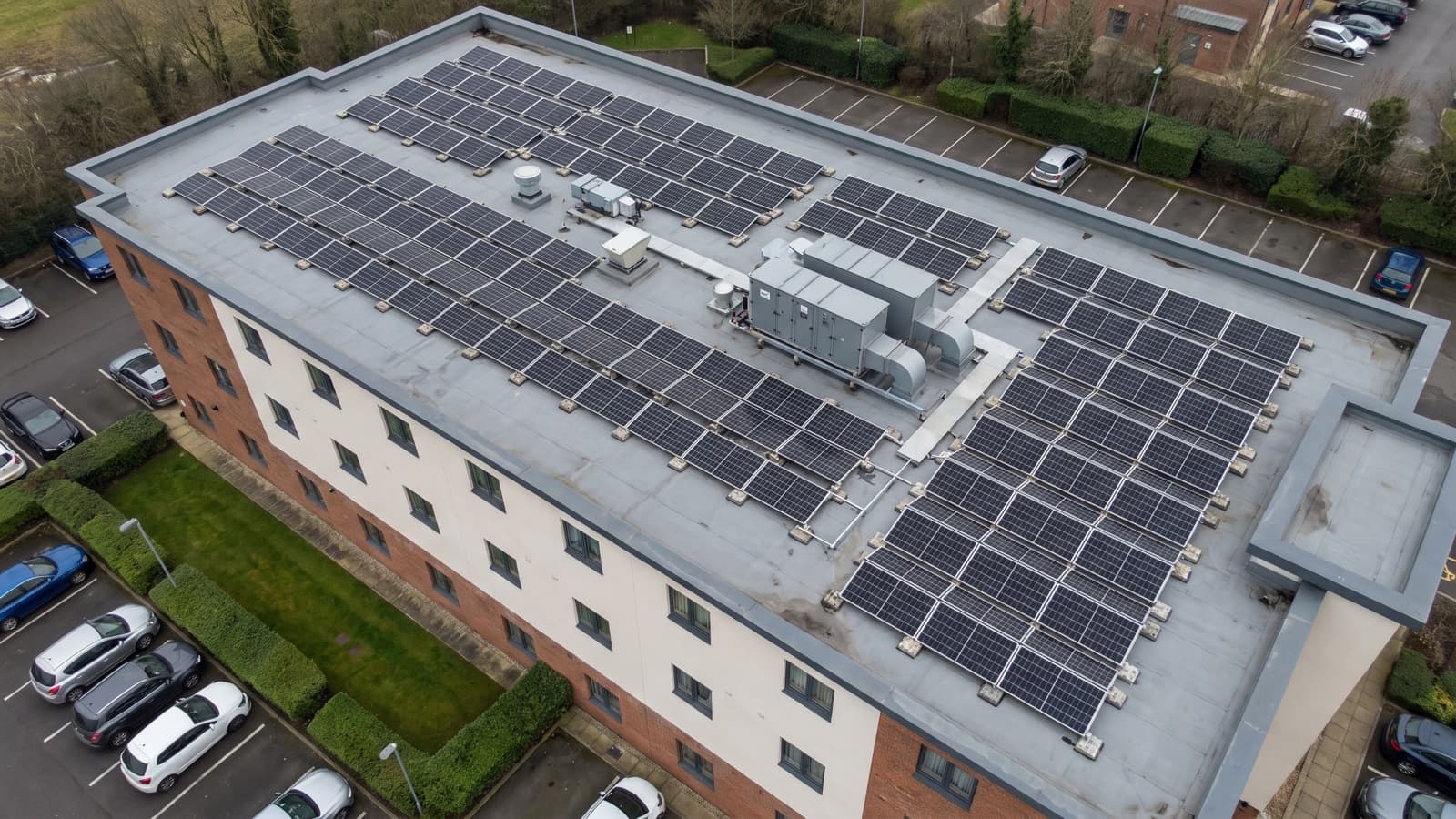
Solar on a hotel or leisure site typically pays back in 4–7 years. Hotels carry a heavy round-the-clock base load — hot water, heating, kitchens, pools, spas and laundry — so they use a high share of what their roof generates rather than exporting it. That high self-consumption is what drives the return, since on-site solar displaces grid power at around 25p per kWh.
Hotels and leisure sites are one of the stronger solar prospects in the commercial range, for a reason that sets them apart from most premises: they never really switch off. Where an office is empty overnight and at weekends, a hotel is heating water, running kitchens and keeping rooms comfortable around the clock. That steady demand means a high share of generation is used on site rather than exported — and self-consumption is what makes the economics work. This guide sets out the real numbers independently. We don't install anything; when you want a figure for your roof, the calculator gives you one in about a minute.
Why hotel roofs work for solar
The case for hotel solar rests on the load profile. A hotel runs a heavy, near-constant base load: hot water, space heating, commercial kitchens, lifts, air conditioning, and — where present — swimming pools, spas and on-site laundry. Unlike a nine-to-five business, that demand continues across daylight hours, through evenings, and at weekends. So when a rooftop array is generating, there is almost always enough on-site demand to absorb it.
That is what makes the difference. Every unit you generate and use yourself displaces a grid unit costing around 25p per kWh, while every unit you export earns far less. Because a hotel's base load soaks up generation rather than spilling it to the grid, its self-consumption rate is high — and a high self-consumption rate is the single biggest driver of a fast payback. Pools, spas and laundry, in particular, are steady daytime loads that the array serves well.
Flat roofs and fire rating
What does hotel solar cost?
Cost depends on system size, and bigger systems cost less per kWp because the fixed costs — scaffolding, design, grid paperwork — spread over more panels. Hotels span a wide range, from a small independent to a large resort or leisure complex with a sizeable roof. As a guide for 2026:
| System size | Typical installed cost | Roughly suits |
|---|---|---|
| 25 kWp | £31,950–£35,000 | Small hotel or B&B, ~£1k–£1.5k/mo bill |
| 50 kWp | £63,900–£70,000 | Mid-size hotel, ~£2k–£3k/mo bill |
| 100 kWp | £80,000–£95,000 | Larger hotel or leisure complex |
| 150 kWp | £112,500–£127,500 | Resort or sizeable leisure roof |
Cost per kWp falls from around £1,300–£1,500 on smaller systems towards £750–£950 above 100 kWp, so a larger roof improves the economics. The headline price isn't the whole story, though — what matters is the cost against the savings it unlocks. Our commercial solar cost guide breaks down exactly what sits inside a quote.
Payback and returns for hotels
Hotel and leisure payback typically lands in the 4–7 year range, with an annual return in the region of 15–30%. The high, steady self-consumption a hotel achieves tends to push a project towards the faster end of that range — closer to the daytime-heavy sectors than to an office, which sits empty for much of the week.
| Building type | Typical payback | Annual ROI |
|---|---|---|
| Hotels / leisure | 4–7 years | 15–30% |
| Offices | 5–7 years | 15–28% |
| Warehousing / logistics | 2–5 years | 22–45% |
A roughly 50 kWp array generating at a typical UK yield of about 950 kWh per kWp a year produces in the region of 47,500 kWh annually. At 25p per kWh, a hotel that self-consumes most of that displaces several thousand pounds of grid electricity each year. Our payback and ROI guide works through the maths in full, including how the returns shift with self-consumption.
Owner-occupied, leased, or part of a group
Most independent hotels are owner-occupied, which is the simplest case: you fund the system, you use the power, and you keep the tax relief and the savings. Where a hotel is leased or operated under a management agreement, the party who funds the system and the party who pays the electricity bill may differ, and that split has to be agreed before anything proceeds.
- Owner-occupier — funds, uses the power, keeps the savings and tax relief. The cleanest path.
- Leased premises — a tenant operator benefits only with landlord consent and enough lease left to recoup the cost, usually 10 years or more.
- Group or branded estate — central capital and standard specifications can make a multi-site rollout efficient, but metering and ownership at each site still need to be settled.
Where the lease is short or the split is awkward, a Power Purchase Agreement (a funder owns the kit, the occupier buys the power) often resolves it without upfront capital. Our financing guide compares the routes.
Planning permission and funding
Rooftop solar usually needs no planning permission. Since December 2023, permitted development rights cover rooftop solar of any size on commercial buildings in England, provided the panels sit at least 1m from the roof edge and don't protrude more than 200mm on a pitched roof, or 1m on a flat roof. The exceptions matter more than usual for this sector: many hotels are listed buildings or sit in conservation areas, which fall outside permitted development and need a planning application. Building regulations always apply. Full detail is on our planning permission guide.
The real subsidy is tax relief
Is your hotel suitable? A quick checklist
A few questions settle most cases before a survey:
- Roof size and condition — you need clear, structurally sound roof area with at least 10 years of life left. At roughly 6 m² per kWp, a 50 kWp system needs around 300 m² of usable roof.
- Flat-roof fire rating — a flat roof covering must achieve BROOF(t4); the structural assessment confirms this.
- Electricity supply — most commercial systems need a three-phase supply; single-phase premises are usually limited to small systems.
- Base load and tenure — the heavier and steadier your daytime use the better, and you need ownership or a long enough lease to recoup the cost. Shaded roofs, short leases and heritage constraints are the usual reasons a site doesn't stack up.
Frequently asked questions
Why do hotels get good returns from solar?+
Hotels run a heavy, near-constant electricity load — hot water, heating, kitchens, lifts, air conditioning, and pools, spas or laundry where present. That base load runs straight through daylight hours, so a hotel uses most of what its roof generates rather than exporting it. Because self-consumed solar displaces grid power at around 25p per kWh while exported power earns far less, high self-consumption is what drives the payback.
Will solar cover a hotel pool or spa?+
It contributes rather than covers. Pool pumps, spa heating and air handling are steady daytime loads, which is exactly the demand solar serves best, so they lift a hotel's self-consumption. But heating water and air is energy-intensive, so a roof array usually offsets part of that load rather than all of it. Sizing the system to your daytime base load, not your peak, is what keeps the economics strong.
Can you put solar on a flat hotel or leisure-centre roof?+
Yes, and many leisure centres and modern hotels have large flat roofs that suit a ballasted, tilted array. The main requirement is that the roof covering carries a BROOF(t4) fire rating, confirmed by a structural and fire assessment before install. The array is set back from the edge to stay within permitted development limits. Period or listed hotels need an earlier planning check, as they often sit outside permitted development.
Does a hotel need to shut down to have solar installed?+
No. A rooftop installation is carried out from the roof and plant areas with minimal disruption to guests, and the panels themselves go up in days to a few weeks depending on system size. The longer part is the grid connection: a G99 application for a system that exports typically takes 8–12 weeks to approve. The installer schedules works around trading, and brief tie-in points are planned for quiet periods.
See what solar could save your business
Enter your roof size, postcode and monthly bill — get your system size, savings and payback in 60 seconds. Free, no obligation.
Get my free estimateRelated guides
Updated June 2026 · By Taro Schenker, founder of Business Solar Check. We're independent — we don't install solar. Figures are indicative UK averages; your site survey confirms the numbers for your roof.